
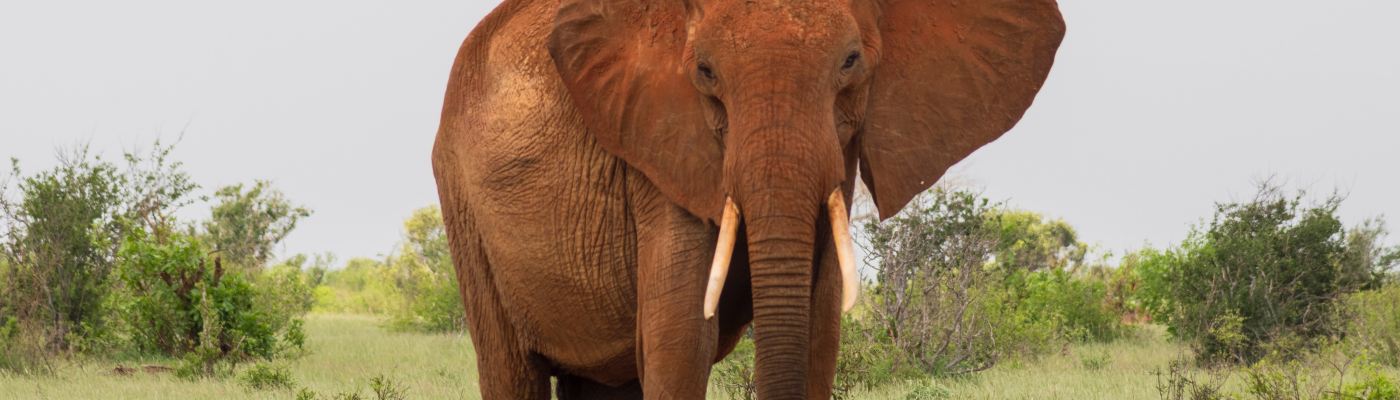
Morula and I seek what little shade there is under a bare Motsheketsane tree (Mot-sheh-key-saw-knee) — its branches interwoven like a dancer’s arms caught in a multiple exposure, reaching into a chalk-blue sky.
Sweat trickles down my neck as I melt and droop. I take sips from my water bottle. Morula searches for leftover seeds. Using her trunk as a leaf blower, whuff, whuff, whuff, she corrals the ones she finds into a neat little pile and transfers them to her mouth.
Motsheketsane seeds look like Oriental paper lanterns, oval with ruffled wings that divide into five horizontal planes. I try to pocket one, but the wings crumble in my hand. I drop it into a fresh pile of dung, dispersing it exactly the way it would pass through an elephant — far enough from the shade of its parent to germinate in warm fertilizer.
Twenty years ago, fresh off a 747 from my home in the United States, I inhaled the air of southern Africa for the first time: a trace of smoke and sweet mulch, combined with the mineral scent of sand, hot fur, and dry dusty trees. The air was soft, warm, familiar — as if all the windows of time had been thrown open and I had breathed in this scent before.
Since 2002, I’ve never travelled to anywhere else but here — Morula’s home in Botswana’s Okavango Delta. To a country where the sand is layered with elephant footprints, where termite mounds have the look of marooned islands, where each footstep takes me nowhere and everywhere all at once, where clouds scrawl an unknown alphabet across the blue sky, glyphs with curlicues and tails, written by winds and airplanes in the upper atmosphere.
Even an elephant is small under such a sky.
My friends, Doug and Sandi offer their guests an opportunity to walk through the bush for several hours with three unfenced and unfettered elephants on a daily foraging trek. I join them for weeks at a time, ambling around with elephants, living at a pace that matches the land around me, following elephant footprints.
Morula reaches out and breaks off several twigs, which crunch in her mouth like sticks of hard candy. The Motsheketsane is one of the first trees to flower in the spring, and the new leaves are a favorite of kudu, impala, eland and elephant. But now, in Botswana’s late fall, the tree carries not a single bud.
As I watch her whuff seeds into another pile, my everywhere-mind wanders off by itself, meanderings of no practical use.
Speculatively, I cloak Morula’s body in long, ginger-colored, shaggy fur, shrink her ears, implant tusks upturned like the tines of a pitchfork, and imagine her, well, tubbier.
She waves her trunk tip at me, a neighborly Hello, as if across a backyard fence.
Her trunk and general body shape argue for a close relationship with both mastodons and mammoths. But recent DNA research found genetic links only between elephants and mammoths, with mastodons predating all modern elephant species. Morula’s family tree looks like this:

Mastodons branched from the proboscidean lineage twenty-six million years ago. They became the first of the elephant cousins to leave Africa, the first to migrate through Asia and the first to arrive in North America, around 3.7 million years ago. Once there, they spread from Alaska to Central Mexico, from the Pacific to the Atlantic.
Long after the mastodon migrated from Africa, the proboscidean cousins it left behind branched into three distinct families: Loxodonta, Elephas and Mammuthus. Loxodonta stayed put, becoming the two species of African elephant — savannah and forest — that survive into the present. Elephas relocated to India and Asia, and eventually evolving into Elephas maximus, the Asian elephant. Mammuthus hit the road, colonizing southern Europe, the Mediterranean region, the Middle East, central Asia, Siberia, and finally North America.
Mastodons and mammoths share many characteristics with elephants. They have the same basic body shape, a trunk, and tusks. But they also differ from modern elephants in many ways.
The most striking, of course, are their layers of hair, head to toe.
Today’s Asian elephants are considered to be hairier than their contemporary African cousins, although calves of both are often born with upright, russet brush-cuts several inches long. Calves gradually lose most of their baby hair, but Asian elephants occasionally retain forelocks that give them, I think, a wonderfully girlish look.
Morula rubs her left haunch against the gnarly trunk of the Motsheketsane. She has plenty of hair, but more like the hair on my arm rather than the hair on my head. Obviously a fur coat is useless under the brassy African sun. Her body size, thick skin, and subcutaneous fat all help to keep her warm when temperatures occasionally dip below freezing.
If you shaved a mammoth or a mastodon, parked it in a zoo, and sold tickets, most people would believe they’re seeing an elephant. But if the three distant cousins were on display, side-by-side, almost anyone could tell the difference among them. Of course, bringing to life two extinct species is an impossibility, unless, well . . . . I make things up.
So, in my mind, I import to Africa two species that never walked the continent having evolved elsewhere: Mammut americanum (the American mastodon) and Mammuthus primigenius (the Woolly mammoth). Both lived exclusively in North America, where fourteen thousand years ago they could be found literally in my backyard.
I position Morula between two cousins she will never meet — a mastodon to her right and a mammoth on her left. Oddly enough, because everyone’s related, they don’t look that much out of place.
The mammoth I’ve somehow already named Primo is completely cloaked in rich, russet fur, trunk and all, right down to his toes. Some of his flank hair is over three feet long. He also has a coat of fine under-wool, and probably shed a lot of it during the Pleistocene summers. His ears are oval-shaped and small, only fifteen inches from top to bottom, dainty really, compared to Morula’s. Hers are four feet long and five feet wide. Since he lived in a world covered with ice, Primo had no need to dissipate heat through his ears. He has a large round dome on the top of his head covered with long dense hair, and a back that slopes from his shoulders to his hips. His posture and woolly hat remind me of some teenagers I know.
Primo is about the same size as Morula, but has absolutely spectacular tusks. Curving out, then inward and up, they are the perfect shape for sweeping aside large swaths of snow. Still, at eight feet long, they’re only half the size of the longest mammoth tusks ever recorded.
He lifts the tip of his trunk and takes a discreet sniff at Morula: Who’s this?
The top “finger” on Primo’s trunk tip is four inches long and the bottom “thumb” two inches — much longer than Morula’s top tip, and about the same size as her bottom one. Primo could easily harvest single petals from spring flowers or extract the newest, sweetest stems from the withered fall grasses regrowing under the snow on the Pleistocene parklands where he once lived.
But now he quickly loses interest in the smell of an unfamiliar elephant and strolls over to a tussock of appropriately-named wool grass, leaving cratered footprints in the dust. Except for the whisk of hair marks alongside them, I can’t tell them apart from Morula’s footprints.
He wraps his trunk around a tuft of the white, feathery grass, from right to left, rips it out, and stuffs it between elephant-like molars. As he eats, I hear a phantom fart. He lifts the small, triangular anal flap at the base of his short, stubby tail and drops a pile of dung. It also looks like Morula’s.
Conjuring Mammut americanum, the American mastodon, is trickier. Frozen, mummified mammoth carcasses have been unearthed in Siberia with tongues hanging out of their mouths, but mastodons are known only by their bones.
So when I give “Manny” a chestnut-colored shag — short and tangled hair on the top of his head, thick and matted fur along his flank — I’m just agreeing with what I’ve read elsewhere. Since Manny mingled with mammoths in the cold wet climate of North America, a shaggy fur coat is probably a safe bet.
Manny is about the same height as the average African elephant. But his back —instead of sloping, like Primo’s, or saddle-shaped, like Morula’s — is straight. He has no neck, built like a table with sturdy legs. Without Primo’s high-domed head or the rounded crown on Morula’s head, his skull looks flatter and longer. Manny turns his head to look at me and blinks once or twice.
While Primo’s tusks curve out and then in, Manny’s are only slightly upturned, like a pitchfork tine. His tusks are thick, about eight feet long, and built for uprooting trees rather than shoveling snow.
One is a full six inches shorter than the other — I have conjured a lefty. Laterality — right or left-handedness — how they use their tusks and trunks, is present in all proboscidean species.
Both mammoths and mastodons grew tusks of great lengths — a sixteen-foot mastodon tusk was found in Greece and a sixteen-foot mammoth tusk was found in Texas. The record for African elephants is eleven feet.
Manny’s tusks, and those of all his cousins, have growth rings like trees, rings with varying thicknesses for bad years and good years. And just as all living elephant species do, he most likely experienced that flood of testosterone called musth in his late teens and began aggressively fighting with other males over receptive females. The bones of male mastodons often show battle scars to tooth sockets, tusks, and skulls. So, although Manny is bulky and looks like a furry table gazing at me, he‘s not just some docile herbivore. He’s a bull in the prime of his life. Lucky for me, I didn’t conjure him up when his testosterone levels were elevated.
Manny joins Morula on the opposite side of her rain bush, reaches in, plucks a full branch, shoves it into his mouth and chews up and down, like I do, instead of forward and back, like Primo and Morula. Each of Manny’s molars has three to four ridges, ridges shaped like a woman’s torso: two breasts with pointed nipple-like chewing surfaces and a valley between them. Mastodon is a combination of the Greek words for breast (mastos) and tooth (odõn.)
In contrast, the molars of Primo and Morula are vegetable graters – ridged plates that grind food back and forth across sharp, upright edges. Morula’s teeth have ten ridges, while Primo’s have twenty-seven.
At birth, Morula had two or three small cheek teeth. By the age of ten, molars weighing eleven pounds each began to erupt in the back of her jaw and move forward, a conveyor belt of teeth, two on a side, top and bottom, eight teeth at a time. As her teeth wear out, they break off in sections at the front, making room for the new molars beginning to grow in the back. Primo has exactly the same molar configuration, but Manny has up to five molars at a time on each side of his jaw.
In her lifetime Morula will have six sets of molars. She’s already on her fifth set, which will last until her early forties. Her sixth set will wear down by the time she is sixty. Only ten percent of aging elephants grow a seventh set of molars.
Manny, Primo, and Morula are ignoring each other, the way anyone would when at a family reunion with distant cousins circling the buffet.
My everywhere-mind wanders off again, wondering what it would be like if mastodons and mammoths were still alive on the continent where I live. Mastodons died out only 11,000 years ago. Four thousand years for mammoths. Both survived through the Pleistocene and into the Holocene, the age of man. They could be roaming in my backyard if climate change and humans hadn’t eradicated them.
I look back at the cousins.
As Primo occupies himself with consuming wool grass and Manny concentrates on demolishing the rain bush, my vision of them begins to fade.
I can see right through them now.
And they are rapidly becoming distressed in the African heat. They sway from side to side and flap their small ears like tiny surrender flags.
Slowly they disappear, back into the past.
Extinct once again.
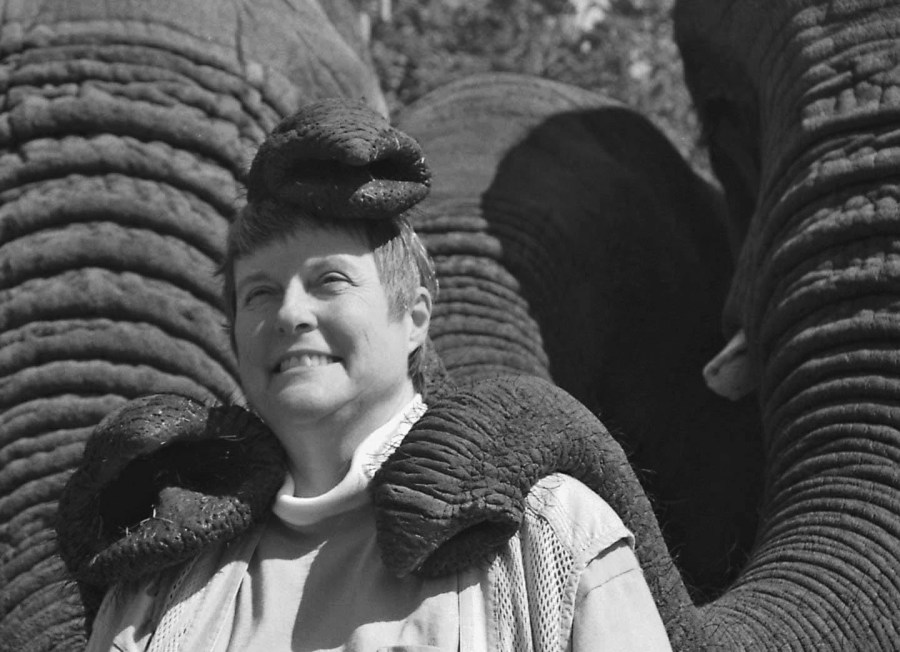
Cheryl Merrill’s nonfiction was selected for Special Mention in Pushcart, Best of the Small Presses 2008, published in Best of Brevity, Creative Nonfiction #27, and Willows Wept Review. An essay “Breathing,” is at Terrain.org 12th Annual Contest in Nonfiction. She is currently working on a memoir about living with a small herd of elephants in Botswana.
Featured Photo by Murad Swaleh on Unsplash
 Sentience Literary Journal